The Dangote cement expansion strategy is accelerating as the company prepares a $1 billion investment across Africa. The goal is to increase production capacity and strengthen its leadership in the regional cement market. Africa’s growing demand for construction materials makes this expansion highly strategic.
The Dangote cement expansion plan will increase production capacity by about 45 percent within four years. When completed, the company expects total annual capacity to reach roughly 80 million tons. This move will further cement its position as Africa’s largest cement producer.
Gbenga Fapohunda, the company’s Chief Financial Officer, shared details during an investor conference call in Lagos. He explained that the investment will target several key African markets. Nigeria and Ethiopia will receive major portions of the funding. Other African countries will also benefit from new plant construction and facility upgrades.
Earlier this year, the company signed a major agreement with Sinoma International Engineering of China. The deal is valued at $1 billion. Sinoma will build new plants and expand existing production facilities. These projects are central to the Dangote cement expansion roadmap.
The partnership with Sinoma is expected to improve efficiency in plant construction. It also helps accelerate project timelines. With faster project delivery, Dangote Cement can quickly meet rising market demand.
Export growth also plays an important role in the Dangote cement expansion strategy. The company plans to increase cement and clinker exports to 10 million tons annually by 2030. This represents a major leap from the 1.4 million tons exported in 2025.
Exports have already begun to grow steadily. Dangote Cement recently reported an 18.6 percent increase in cement and clinker exports from Nigeria. During the year, the company shipped 34 cargo vessels loaded with clinker. These shipments were delivered mainly to Cameroon and Ghana.
The export strategy supports Nigeria’s position as a regional manufacturing hub. Producing cement domestically while exporting excess supply helps strengthen the country’s industrial base. It also improves regional trade across West and Central Africa.
Financing for the Dangote cement expansion will come from several sources. The company plans to rely partly on operating cash flow generated by existing plants. Additional funding will come from supplier credit, commercial papers, bonds, and bank loans.
This diversified financing structure helps maintain financial stability. It also allows Dangote Cement to pursue expansion without over-reliance on a single funding source.
Group Managing Director Arvind Pathak has repeatedly emphasized the company’s commitment to growth. According to him, Dangote Cement will continue commissioning new production capacity across Africa. Expansion projects are underway in Ethiopia, Cameroon, South Africa, Zambia, and Senegal.
One major project within the Dangote cement expansion plan is the Itori cement plant in Nigeria. The facility will produce six million metric tonnes of cement per year. Once completed, it will become one of the company’s most important production sites.
The Itori plant represents a transformational project for the company’s supply network. It will significantly increase cement availability in Nigeria. It will also support export shipments to nearby markets.
Demand for cement across Africa continues to rise rapidly. Population growth, urbanization, and infrastructure development all require large volumes of building materials. Governments are also investing heavily in roads, housing, bridges, and industrial zones.
These trends strongly support the Dangote cement expansion strategy. By increasing production capacity, the company can capture growing market demand across multiple regions.
The company’s financial results already reflect strong market performance. Dangote Cement recently reported its highest profit in history. Revenue increased by 20.3 percent to N4.3 trillion, which equals about $3.14 billion.
Interestingly, this revenue growth occurred despite a slight drop in sales volumes. The results highlight the company’s focus on margin protection and cost efficiency. Strong pricing strategies also helped support profitability.
Another financial development supporting the Dangote cement expansion plan involves the company’s commercial paper program. Dangote Cement recently issued Series 1 and Series 2 commercial papers under a N500 billion issuance program.
The Series 1 instrument raised N19.95 billion. It carries a maturity period of 181 days and will mature in May 2026. Meanwhile, the Series 2 issuance raised N99.92 billion with a 265-day tenor.
Both instruments were issued at a discount. Investors will receive repayment at the full par value of N1,000 upon maturity. The securities provide attractive yields of 17.5 percent and 19 percent respectively.
These financial tools help support the Dangote cement expansion program. They also provide investors with opportunities to participate in the company’s growth.
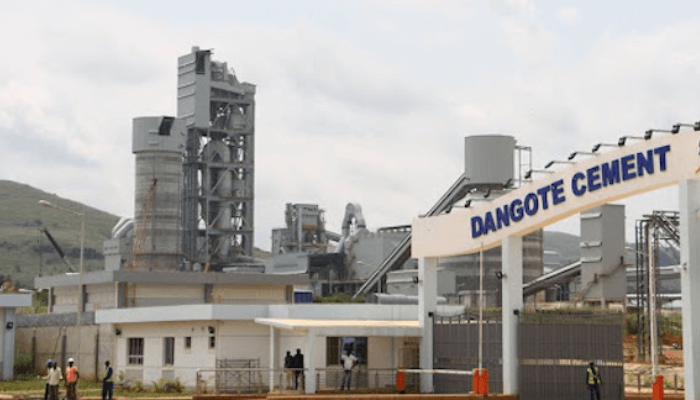
Dangote Cement already operates several large production facilities outside Nigeria. One major plant occupies a 50-hectare industrial site capable of producing three million metric tonnes annually. Facilities like this strengthen the company’s continental supply network.
By operating plants across different regions, the company reduces transportation costs. It also improves distribution efficiency across multiple markets.
Africa’s rapid urbanization continues to create strong demand for cement. Cities across the continent are expanding quickly. New housing developments, highways, and industrial parks all require large quantities of construction materials.
Therefore, the Dangote cement expansion initiative is well timed. By increasing production capacity and strengthening exports, the company is positioning itself for long-term growth.
If these projects progress as planned, Dangote Cement will significantly expand its production footprint. At the same time, Africa’s construction sector will benefit from stronger local manufacturing capacity.
READ: NNPC Revenue Stream Reshaped by Landmark Executive Order