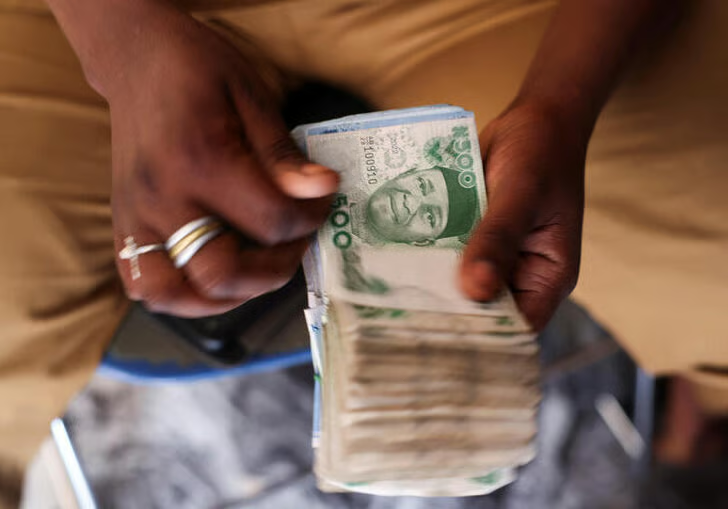
In a landmark decision, Jersey has agreed to return £7 million (more than $9.5 million) of “tainted” funds to the Government of Nigeria, which were previously held in a Jersey bank account. The money, believed to have been illicitly obtained, will now be allocated to support vital infrastructure projects in Nigeria, particularly in the final stages of completing a key highway connecting the country’s capital, Abuja, to its second-largest city, Lagos.
This move follows a ruling by the Royal Court of Jersey, which found that the funds were “more likely than not” proceeds of a corrupt scheme in which third-party contractors diverted government funds meant for public projects, benefiting senior Nigerian officials and their associates.
The Background of the Funds’ Repatriation
The funds were held in a Jersey bank account and were deemed to be the result of corruption related to government contracts. The case, which has been ongoing for several years, is part of a larger global effort to trace and repatriate illicit assets that have been moved to foreign jurisdictions, often in offshore financial centers like Jersey.
The successful return of these funds follows two previous agreements between Jersey and Nigeria, which saw more than $300 million (£230 million) in stolen assets repatriated to Nigeria. These agreements were part of a broader effort to combat corruption and illicit financial flows, with Jersey’s civil forfeiture legislation being used as a powerful tool to recover assets acquired through corrupt means.
In December 2025, His Majesty’s Attorney General for Jersey, Mark Temple KC, signed a Memorandum of Understanding (MOU) that formalized the return of the £7 million to Nigeria. This agreement built on previous legal frameworks that have allowed for the repatriation of stolen assets, a crucial step in Nigeria’s ongoing battle against corruption.
Nigeria’s Response and the Use of the Repatriated Funds
The Nigerian government, led by Attorney-General and Minister of Justice, Lateef Fagbemi, welcomed the repatriation of the funds and emphasized their importance for the country’s infrastructure development. Fagbemi noted that the funds would be used for a critical infrastructure project—the completion of a stretch of highway connecting Abuja to Lagos. This highway is seen as a vital link for transportation and economic activity between the two major cities, and the repatriated funds will help complete the final stages of the project.
Fagbemi also highlighted the significance of the asset recovery, stating that it demonstrated Nigeria’s effective collaboration with international partners in ensuring that there is no safe haven for illicitly acquired wealth. The successful return of these assets sends a strong message that countries involved in the fight against corruption will work together to hold wrongdoers accountable and recover stolen funds.
“The successful recovery and repatriation of the forfeited assets underscores the effectiveness of Nigeria’s collaborative efforts with its international partners in ensuring that there is no safe haven for illicitly acquired wealth or assets moved to foreign jurisdictions,” Fagbemi said in a statement.
The Legal Mechanisms Behind the Return
The repatriation of the £7 million was made possible through Jersey’s civil forfeiture laws, which allow authorities to seize and return illicit assets that have been moved to foreign countries. These laws have played a crucial role in combatting international corruption by providing a legal framework for the recovery of stolen funds.
Temple, Jersey’s Attorney General, emphasized the importance of these civil forfeiture laws in ensuring that assets derived from criminal activity do not remain protected in foreign bank accounts. He called the repatriation a demonstration of the strength of Jersey’s legal system in combating corruption globally, noting that it serves as a powerful deterrent to those who seek to hide stolen wealth in offshore accounts.
“The return of these funds demonstrates the strength of our civil forfeiture legislation as a powerful tool in the fight against corruption,” Temple said. “It is a clear message that illicit wealth will not find sanctuary in Jersey or any other jurisdiction that is committed to upholding the rule of law.”
A Global Effort to Combat Corruption
This repatriation is part of a larger, ongoing effort by the international community to combat corruption and illicit financial flows. Many countries, particularly in Africa, have struggled with the problem of officials using public funds for personal gain and hiding the proceeds in foreign bank accounts. The repatriation of stolen assets has become a key focus of international anti-corruption efforts, with various countries working together to track, seize, and return illicitly acquired funds.
The return of these funds to Nigeria also demonstrates the importance of international cooperation in combating corruption. It is a reminder that no country is immune to the problem of illicit financial flows, but through collaboration and effective legal frameworks, stolen assets can be recovered and used for the benefit of the people.
The Nigerian government has already made significant strides in addressing corruption, but there is still much work to be done. The successful return of the £7 million will help fund crucial infrastructure projects that will benefit Nigerians for generations to come. However, the fight against corruption must continue, with more efforts focused on strengthening institutions, ensuring transparency, and holding those responsible for corruption accountable.
A Step Forward in Nigeria’s Fight Against Corruption
The return of £7 million from Jersey to Nigeria marks a significant victory in the ongoing battle against corruption and illicit financial flows. It highlights the importance of international cooperation in recovering stolen assets and using them for the greater good. The funds will contribute to the completion of a vital infrastructure project, helping to improve transportation and economic connectivity between Nigeria’s capital and its second-largest city.
As the international community continues to address the problem of corruption, the repatriation of illicit assets should serve as both a warning and an inspiration. It is a reminder that no one is above the law and that corrupt officials will not be able to hide their wealth in foreign jurisdictions indefinitely. With continued efforts and collaboration, countries like Nigeria can work towards a future free from the scourge of corruption and the misallocation of public resources.