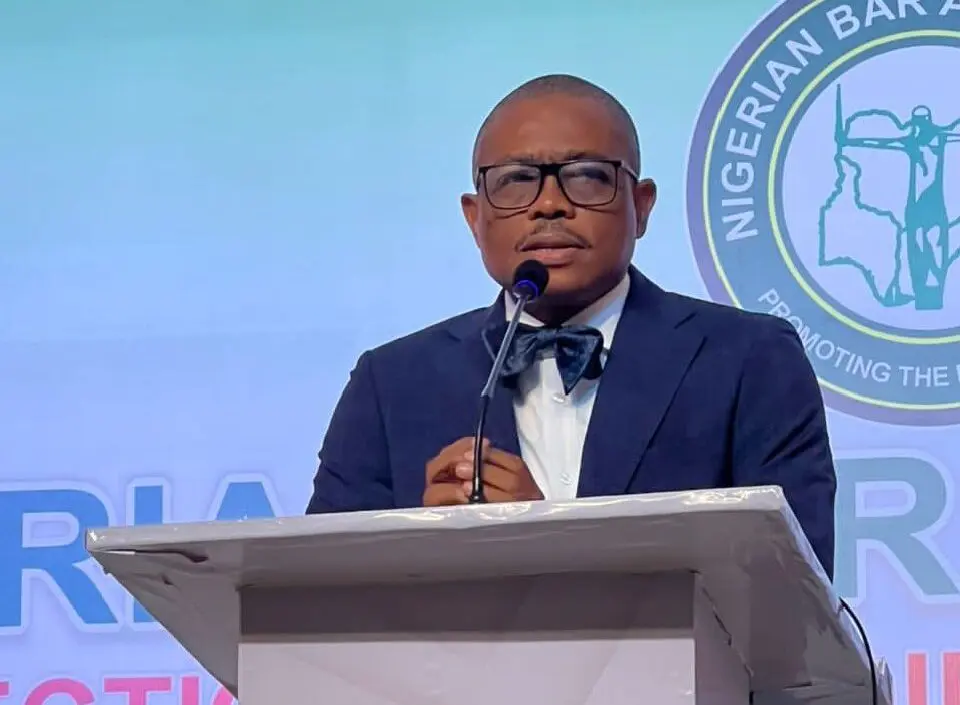
Nigerian Bar Association (NBA) President Afam Osigwe, SAN, has raised serious concerns about the Cybercrimes Act misuse Nigeria. Specifically, he warned that authorities are using the law to silence dissent under the pretense of fighting cybercrime. During an interview on ARISE Television’s Prime Time programme, Osigwe said officials increasingly target journalists, activists, and ordinary citizens for criticizing public figures—whether online or offline.
Moreover, he noted that police often charge these individuals with cybercrime or criminal defamation. In many cases, these offences are bailable by law. Yet, courts routinely deny bail without clear justification. “Free speech is being muzzled in Nigeria under the guise of charging people to court,” Osigwe stated.
He went further to accuse some judges and magistrates of serving political interests. “Even when matters are ordinarily bailable, judges and magistrates increasingly appear to act as tools for politicians and ‘big men,’” he said. Consequently, courts risk becoming instruments of oppression rather than justice.
Osigwe emphasized that this trend violates constitutional rights. “This is a clear violation of the right to freedom of expression,” he declared. He added that democracy suffers when citizens cannot hold leaders accountable. Public office holders, he argued, must face higher scrutiny—not less.
Furthermore, he warned that judicial cooperation worsens the problem. “If judges willingly help remove critics from public life, then something is deeply wrong,” he explained. In his view, such actions turn the judiciary into an enabler of oppression. Ultimately, it becomes part of the problem rather than the solution.
His comments arrive amid growing criticism of the Cybercrimes (Prohibition, Prevention, etc.) Act. The government enacted the law in 2015 and amended it in 2024 to tackle online fraud and cyberterrorism. However, legal experts argue that vague language—especially around “cyberstalking”—opens the door to abuse.
In practice, authorities often use these provisions to punish whistleblowers and opinion sharers. As a result, the Cybercrimes Act misuse Nigeria has sparked widespread concern among civil society groups. They fear the law stifles legitimate discourse and shields corrupt officials from exposure.
Therefore, Osigwe called on lawyers, judges, and citizens to defend democratic freedoms. He urged the judiciary to uphold its independence and reject politically motivated cases. Without such vigilance, he cautioned, Nigeria’s democracy could erode—even through laws meant to protect it.