Agriculture remains one of the most important pillars of Nigeria’s economy. In 2026, the sector continues to employ a large share of the population, supply food for a rapidly growing nation, and contribute significantly to export earnings. Despite its importance, Nigeria’s agricultural sector faces persistent structural challenges even as new opportunities emerge through technology, policy reforms, and private investment.
As population growth, climate pressures, and economic diversification reshape national priorities, agriculture stands at a critical crossroads. The decisions made in 2026 will influence food security, rural livelihoods, and long-term economic stability.
The Importance of Agriculture to Nigeria’s Economy
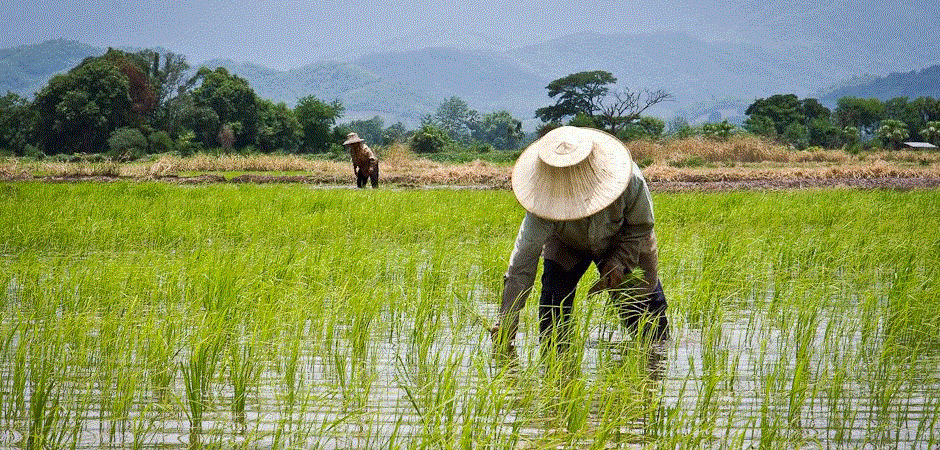
Agriculture remains a major source of employment in Nigeria, particularly in rural areas where farming is often the primary livelihood. Millions of smallholder farmers cultivate crops such as rice, cassava, maize, sorghum, and yams, while livestock farming supports household incomes across different regions.
Beyond employment, agriculture plays a strategic role in reducing food imports and strengthening foreign exchange reserves. In recent years, Nigeria has increasingly focused on boosting domestic production to meet local demand and reduce reliance on imports. In 2026, this objective remains central to national economic planning.
Key Opportunities in Nigeria’s Agricultural Sector
One of the strongest opportunities lies in Nigeria’s vast arable land and favorable climate. Large portions of the country remain underutilized, offering room for expansion and commercialization. With improved irrigation, mechanization, and access to inputs, productivity gains are achievable across multiple value chains.
Agro-processing presents another major opportunity. Rather than exporting raw produce, Nigeria has the potential to add value through processing and packaging. This shift can increase farmer incomes, create jobs, and reduce post-harvest losses. Crops like cassava, rice, cocoa, and oil palm are particularly well-positioned for value addition.
Technology adoption is also transforming agriculture in 2026. Digital platforms help farmers access market prices, weather forecasts, extension services, and financial products. Mobile-based solutions connect smallholders to buyers and lenders, improving transparency and efficiency across supply chains.

Role of Agribusiness and Private Investment
Private sector participation continues to grow within Nigeria’s agricultural sector. Agribusiness firms invest in large-scale farming, storage facilities, logistics, and processing plants. These investments help modernize production systems and integrate smallholders into formal value chains through out-grower schemes and contract farming.
Startups focused on agri-tech play a growing role as well. They introduce innovations in precision farming, input distribution, and farm management. In 2026, these solutions help farmers optimize yields while reducing waste and costs.
Access to finance remains a key enabler for agribusiness expansion. While challenges persist, increased collaboration between banks, development partners, and fintech platforms has improved credit availability for farmers and agribusinesses.
Government Policy and Support Programs
Government policy continues to shape the direction of agriculture in Nigeria. In 2026, policy emphasis remains on food security, import substitution, and rural development. Support programs focus on improving access to inputs, strengthening extension services, and encouraging youth participation in agriculture.
Investment in rural infrastructure, such as roads and storage facilities, is critical for connecting farmers to markets. Where infrastructure improves, farmers benefit from lower transport costs and reduced post-harvest losses.
However, policy consistency remains essential. Frequent changes in regulations or trade restrictions can disrupt planning and discourage long-term investment.
Major Challenges Facing the Sector
Despite its potential, Nigeria’s agricultural sector faces significant challenges in 2026. Smallholder dominance limits economies of scale, while low mechanization levels reduce productivity. Many farmers still rely on traditional tools and rain-fed systems, leaving them vulnerable to climate variability.
Climate change presents an increasing threat. Irregular rainfall, flooding, and rising temperatures affect crop yields and livestock health. Without widespread adoption of climate-smart practices, these risks could undermine food security.
Access to quality inputs such as seeds, fertilizers, and animal feed remains uneven. High costs and supply disruptions limit adoption, particularly among small-scale farmers. In addition, insecurity in some farming regions disrupts production and discourages investment.
Post-Harvest Losses and Market Access
Post-harvest losses remain a major challenge. Poor storage facilities, inadequate processing capacity, and weak logistics systems result in significant waste. These losses reduce farmer incomes and contribute to food price volatility.
Market access is another concern. Many farmers struggle to connect with reliable buyers or receive fair prices. Middlemen often dominate value chains, limiting transparency and bargaining power for producers.
Improving storage, transportation, and market linkages is essential for maximizing agricultural output and stabilizing food supply.
Youth and the Future of Farming
Engaging young people is critical for the future of Nigeria’s agricultural sector. In 2026, agriculture increasingly appeals to youth through agribusiness, technology, and value-added opportunities rather than traditional subsistence farming.
Training programs, access to land, and financing tailored to young entrepreneurs can help reposition agriculture as a viable and attractive career path. Youth participation brings innovation, energy, and digital skills that can accelerate sector transformation.
Nigeria’s agricultural sector in 2026 presents a complex mix of opportunities and challenges. Vast resources, growing demand, and technological innovation offer strong growth potential. At the same time, structural constraints, climate risks, and infrastructure gaps require coordinated solutions.
With sustained investment, supportive policies, and inclusive value chains, agriculture can remain a powerful driver of food security, employment, and economic diversification. The path forward depends on turning opportunity into productivity while building resilience across Nigeria’s farming systems.